BlueCrest Recovery Center


BlueCrest Recovery Center 3 photos

Comparison facts and sources
Woodland Park outpatient continuum with partial care, intensive outpatient and standard outpatient treatment, plus aftercare and sober-living support. · 482 Notch Road, Woodland Park, New Jersey 07424
- Published fee information
- Quote required
- Before admission
- The detailed Woodland Park program page describes partial care, IOP, outpatient care and detox referrals, while broader network pages advertise detox and residential services. The programs page says Suboxone is not prescribed, but the family page describes buprenorphine as available. Confirm the accepting site, current medication policy and continuity of prescribed treatment with the admitting clinician before making arrangements.
- Continuing care
- Case management can help arrange sober living and aftercare services, and the provider describes referrals for medical, mental-health, employment and legal needs plus continuing 12-step participation.
Source record · 2026-10-19
Reviewed October 19, 2026: Woodland Park and broader network services, including conflicting Suboxone/buprenorphine information. Confirm the treating location, individual suitability, medication continuity, availability, insurance coverage and personal costs.. Confirm campus, clinical placement, age criteria, insurance authorization and personal cost directly with BlueCrest.
Luxury rehab comparison · Fees and inclusions · Selection methodology
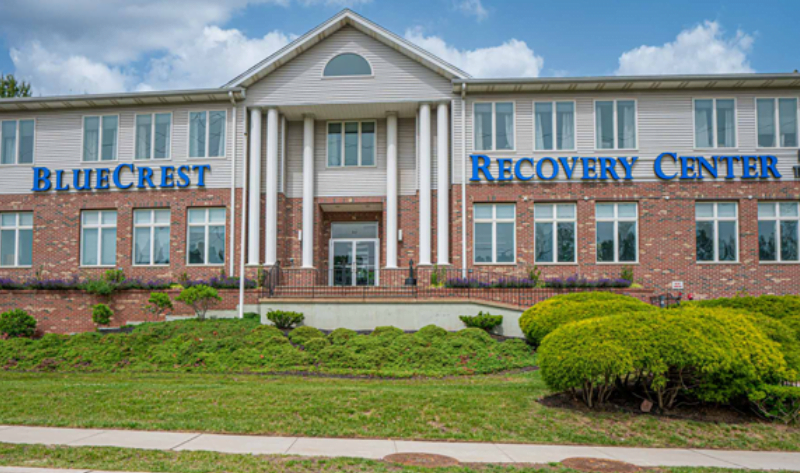
BlueCrest Recovery Center provides outpatient addiction and co-occurring mental-health treatment at 482 Notch Road in Woodland Park, New Jersey. Its detailed Woodland Park program information describes partial care, intensive outpatient and standard outpatient care, with detox referrals. Broader network pages advertise residential and detox services, so the accepting site and level of care should be confirmed.
BlueCrest lists partial care Monday through Friday from 9 a.m. to 3 p.m., daytime and evening intensive outpatient schedules, and outpatient visits once or twice weekly. Care can include individual, group and family therapy, 12-step education, meditation, yoga and life-skills work, with intensity and duration based on assessment.
Current contact: 482 Notch Road, Woodland Park, NJ 07424; +1 888-292-9652. The provider states that it accepts most major private insurance and can discuss private-pay options. Coverage and personal cost require individual verification; no universal self-pay price is published.
Start with the Woodland Park program, then confirm any transfer
BlueCrest’s website presents a broader network alongside its Woodland Park services. The current provider overview advertises a continuum that includes detox, residential treatment and recovery support. Those network descriptions do not identify every service as taking place at 482 Notch Road. Someone arranging an admission should receive the name and address of the actual treating program before making travel or housing commitments.
This matters when a person needs overnight medical observation, has another significant health condition, or is considering primary mental-health treatment without an addiction diagnosis. Ask which team conducts the initial assessment, whether BlueCrest provides the recommended care itself, and whether another organization would receive the referral. If care involves more than one provider, request a separate explanation of consent, records transfer, transportation and billing. A convenient single inquiry should still lead to a clear understanding of who will deliver each part of treatment.
Medication arrangements need a direct clinical conversation
The detailed programs page describes outpatient assessment, case management, referrals for detox elsewhere and Vivitrol assessment and administration. It also says BlueCrest does not prescribe Suboxone or endorse maintenance treatment. A separate current family-program page describes buprenorphine as available, so the website does not establish a consistent policy for that medication.
Anyone already taking medication for an opioid-use disorder should ask the admitting clinician how the existing prescription will be managed, which prescriber will remain responsible and whether an outside appointment is necessary. Do not interpret conflicting website text as an instruction to stop or switch a medicine. Obtain an individualized plan before changing treatment or traveling. The practical issue is continuity: when the next prescription is due, how a missed appointment will be handled, and how outpatient staff coordinate with a detox or other referring service when a transfer is recommended.
Partial care requires a substantial weekday commitment
BlueCrest describes partial care as its most intensive outpatient option. Its partial-care information outlines a structured therapeutic day while participants live outside the treatment building. This arrangement should be evaluated as a combination of daytime care and a separate evening environment, rather than assuming that a full schedule includes overnight clinical supervision.
The published weekday timetable creates practical questions about commuting, meals, employment leave and responsibilities at home. Request the current calendar for the proposed start date and an explanation of which sessions are clinical treatment, skills practice or complementary activities. BlueCrest discusses yoga, meditation and other supportive activities; these should be understood within the overall plan, with the clinical team explaining their purpose. A person who cannot manage safely between treatment days needs that concern assessed before enrollment. Progress reviews should also clarify when a less intensive schedule becomes appropriate and what support remains during that transition.
Intensive outpatient schedules differ by stage of care
The intensive outpatient program page describes three-day and five-day schedules. Published daytime sessions run from 9 a.m. to noon on weekdays, with an evening option from 6 p.m. to 9 p.m. on Monday, Wednesday and Friday. The provider describes movement from more frequent to less frequent attendance according to treatment goals, rather than a single timetable for everyone.
Before committing, compare the actual attendance requirement with work shifts, caregiving and travel time. Ask whether a place is available in the preferred group and what happens when illness or an unavoidable appointment interrupts attendance. BlueCrest’s discussion of outside recovery meetings means the total weekly commitment may exceed the listed clinical hours. Clarify which activities are required and which are choices. If a participant lives in recovery housing, establish how transportation and evening support are organized independently of the scheduled outpatient sessions.
Standard outpatient care keeps a smaller clinical footprint
BlueCrest’s standard outpatient description lists attendance once or twice a week, with day and evening arrangements, and describes monthly individual therapy alongside access to psychiatric assessment and medication management. This is a different level of contact from partial care or intensive outpatient treatment. Someone comparing programs should ask how much individual time is planned, who provides it and how concerns between appointments are addressed.
The provider also emphasizes participation in a recovery community, including a sponsor and outside meetings within its twelve-step approach. Discuss whether that framework fits the person’s preferences and existing support system. A workable outpatient plan should identify specific goals that can be practiced away from the clinic, such as managing a difficult workday, handling family conflict or attending a prescribing appointment. The timing of future reviews matters more than assuming that fewer weekly visits automatically mean every concern has resolved.
Co-occurring care should address the person’s actual diagnoses
The dual-diagnosis page describes treating substance-use and mental-health concerns together through BlueCrest’s outpatient levels. It discusses approaches such as cognitive behavioral therapy, dialectical behavior therapy, group work and medication review. A list of therapies is a starting point for assessment; it does not establish that every participant receives the same combination or that every level can support the same severity of symptoms.
Bring information about current diagnoses, previous hospital stays, medications and the most difficult daily symptoms. Ask the team to explain which problems it proposes to address directly and which require another clinician. For example, it should be clear how an existing psychiatrist remains involved, whether the outpatient timetable accommodates that care and who coordinates changes. Treatment planning can then connect addiction work with measurable mental-health goals, rather than leaving a second diagnosis as a label that does not influence the program.
Family support can be available without a relative enrolling
BlueCrest’s family-program page describes free family groups that can be attended even when a loved one has never been a BlueCrest patient. It publishes Wednesday in-person and online sessions, with different times for the two formats. Confirm the current schedule, time zone and registration process before attending, particularly if joining remotely from outside New Jersey.
The group description focuses on communication, boundaries and understanding addiction. Relatives can ask whether a general educational group or an individual family appointment best matches their concern; these are different forms of support. Patient-specific conversations also require an appropriate consent arrangement. This page is the source of the buprenorphine statement that conflicts with the main programs page, so families should not use its medication wording to predict a relative’s prescription plan. Family participation can support care while leaving clinical decisions with the patient and treating professionals.
Recovery housing needs its own practical review
The sober-living information describes housing that supports routines, accountability and a recovery community. Housing and outpatient treatment serve different purposes. A place to sleep does not establish that nurses or medical withdrawal services are present overnight, and the published description does not provide a universal room arrangement or capacity for every property.
Request the proposed home’s address, operator, house rules and charges separately from the clinical treatment plan. Questions about roommates, accessibility, medication storage, visitor rules and travel to the clinic can substantially affect daily life. Ask who can respond after treatment hours and what happens if the accommodation no longer meets the person’s needs. Someone returning to a supportive home may need a different arrangement from someone traveling into New Jersey. The decision should follow the assessment and a realistic review of the evening environment, rather than treating recovery housing as an automatic part of enrollment.
Understand the roles behind the team list
BlueCrest’s team page identifies a medical director, psychiatric nurse practitioners, clinical supervisors and case-management leadership. These roles suggest several points of coordination, but a staff biography does not specify how often a particular professional meets every participant. Ask which clinician will lead the individual plan and how prescribing, therapy and practical support communicate with one another.
For a person with complicated medication needs, it is useful to understand the timing of the initial psychiatric review and follow-up availability. For someone balancing work, housing or appointments elsewhere, the case manager’s role may be equally important. Ask who handles an urgent administrative problem and who handles a change in symptoms. Knowing the distinction helps a family or participant direct concerns appropriately, without assuming that every listed staff member is continuously available or assigned to their case.
Aftercare should translate goals into appointments and routines
The aftercare description emphasizes an individualized plan for maintaining support after the initial phase of treatment. It discusses coping with triggers, continuing connections and practical assistance. The useful question is how those broad aims become a plan the person can follow when the daily treatment structure ends.
Before leaving a higher level of care, ask for the names of intended follow-up providers, appointment dates and a way to transfer relevant records with consent. Review what will happen if an appointment is unavailable or insurance changes. Work and home routines also deserve attention: the plan can identify likely difficult situations, preferred support contacts and the steps for requesting reassessment. An aftercare recommendation should not be mistaken for a confirmed booking. Clarify which arrangements BlueCrest completes, which require an outside provider to accept the referral and which remain the participant’s responsibility.
Alumni activities complement continuing professional care
BlueCrest’s alumni-services page describes educational seminars, practical skills work, group support and monthly events. It also refers to case-management and job-placement assistance. These activities can provide a continuing connection, but assistance finding work is not a promise of employment, and an alumni event does not replace a needed clinical appointment.
Ask what is currently running, whether participation has a fee and which activities are available remotely. Someone moving away after treatment may need a local recovery community in addition to occasional contact with BlueCrest. It is also helpful to separate social events, peer support and professionally delivered therapy when planning the next stage. Each offers a different kind of contact. A realistic plan accounts for how the person will stay engaged during busy periods and how to seek a clinical review if symptoms or substance use begin to interfere with daily functioning again.
Get a program-specific financial estimate
The insurance-verification process asks for plan information so the provider can review benefits and discuss likely personal costs. That review should identify the actual outpatient level and schedule being proposed. Coverage for one service does not establish payment for a separate detox provider, recovery home or outside medical appointment.
Request an itemized estimate that distinguishes treatment charges from housing, transportation, medications and other services. Ask how authorization is reviewed, what happens if the approved level changes and when another estimate will be provided. If paying privately, obtain the unit of charging and the terms for missed visits or early departure. Keep the insurer’s and provider’s explanations together, including any reference numbers and dates. The aim is to understand the likely financial commitment for the assessed plan, without treating a general statement about accepting private insurance as confirmation that every expense is covered.
Compare the care setting with other New Jersey treatment options and the directory’s substance-use treatment guide.
Provider information reviewed October 19, 2026. Availability, medication policies, placement and personal costs require confirmation.
Official sources checked October 10, 2026: programs and schedules, insurance verification, and contact.