Ohio Addiction Recovery Center



Ohio Addiction Recovery Center 3 photos
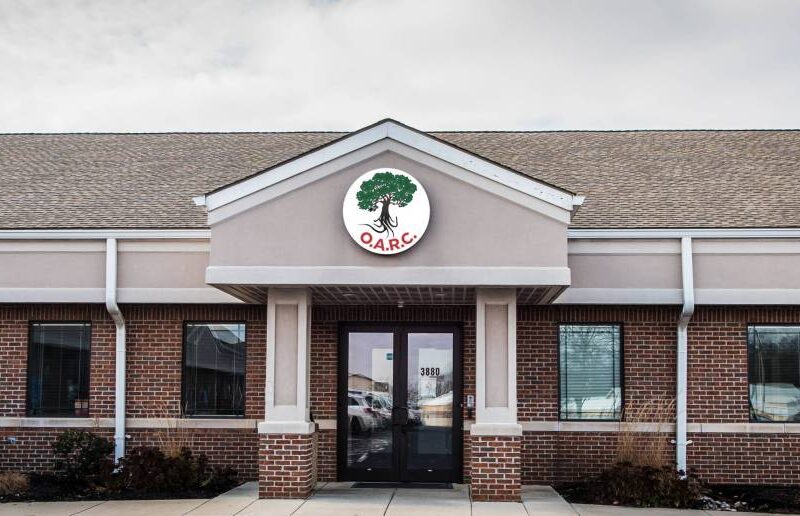


Ohio Addiction Recovery Center (OARC) provides adult substance-use treatment at 3880 Jackpot Road in Grove City, near Columbus, Ohio. Its current continuum includes medical detox and residential rehabilitation, followed by non-residential partial hospitalization (PHP), intensive outpatient (IOP) and outpatient care. PHP clients return home or to sober living in the evening; IOP and outpatient clients continue living at home.
Published timing varies by level of care: the detox-only FAQ describes 7–14 days, while other current detox descriptions give different ranges; PHP typically comprises 15–20 sessions, five days per week with two three-hour sessions per day; and IOP is described as six weeks, three days per week with three-hour sessions. These are program-specific guides, not one guaranteed length for every patient.
OARC says it is in network with most insurance plans and can accept some state plans, but not Medicare or out-of-state Medicaid. Benefits, medical necessity, authorization and patient costs require individual verification. No universal self-pay package or tax treatment was verified.
Medical detox can be arranged as a separate service
OARC’s medical detox page describes round-the-clock nursing and clinical monitoring, assessment, medication support where appropriate, and planning for further care. It explicitly allows detox-only admissions, including people who intend to continue treatment elsewhere. Choosing detox therefore does not automatically require purchasing an entire residential program at OARC.
The same page gives several duration descriptions: seven to ten days in its service list, seven to fourteen days for detox-only care, and five to fourteen days in another FAQ. These are provider-published ranges, not an individualized withdrawal timeline. Ask the medical team what the assessment suggests for the proposed stay and how changes would affect the next placement. The important practical question is how the transition will be organized: who confirms acceptance at the receiving service, how records are transferred, and what support will be available between programs.
Residential treatment and the living arrangement
The residential program description places OARC in Grove City near Columbus and describes an assessment-led pathway into the appropriate care level. The initial conversation reviews substance use, health concerns and treatment history. The clinical team considers medical stability, psychological needs and the living environment when recommending a setting.
The residential page describes semi-private bedrooms, common areas, catered meals, individual and group work, exercise and other structured activities. A residential admission should not be assumed to include a private bedroom merely because the center also markets services to professionals. Ask which accommodation is actually available and whether any alternative carries a separate charge. The page describes discharge planning with a case manager and possible outpatient or sober-living referrals. Those future arrangements should be confirmed individually; a place in residential care does not establish a reserved bed or payment arrangement in a later housing program.
PHP is a substantial daytime commitment
OARC’s partial hospitalization program runs five days a week, with two three-hour sessions per day. The page describes a typical course of fifteen to twenty sessions, adjusted for clinical need and progress. Because it uses both daily and session-based descriptions, ask the team to translate the proposal into actual attendance dates rather than calculating a fixed stay from the headline count.
PHP includes group and individual therapy, skills work and case management, with psychiatric input when appropriate. Participants live at home or in a sober-living arrangement outside treatment hours. The program can follow residential care or, after assessment, serve as an entry point for someone who does not need around-the-clock supervision. Ask who arranges housing, whether it is operated separately, and what it costs. The published daytime program does not itself establish overnight clinical staffing or an all-inclusive residential package.
IOP and lower-frequency outpatient support
The outpatient page describes IOP as three days weekly, with three-hour sessions, over at least six weeks. It includes groups, individual sessions, treatment assignments, life skills, relapse-prevention work, drug testing, peer support and case management. Lower-frequency outpatient care can follow, with the schedule developed alongside the counselor.
This makes IOP a defined treatment commitment rather than occasional check-ins. Someone returning to employment or family responsibilities should obtain the actual appointment times and attendance requirements. OARC describes a short phone assessment that is passed to its medical and clinical team to help recommend a level of care. A preference for outpatient treatment does not establish that it is suitable. Ask what the team would recommend if withdrawal, mental health symptoms or the home environment make the proposed arrangement difficult, and how continuing individual care will be coordinated when the group schedule reduces.
Co-occurring mental health needs remain part of addiction care
The dual-diagnosis program describes substance-use treatment alongside assessment and care for co-occurring mental health concerns. OARC lists depression, anxiety, trauma-related needs, bipolar disorder and borderline personality disorder among the presentations discussed. It describes psychiatric evaluation and medication management as part of a coordinated plan.
These descriptions should not be read as an unrestricted primary psychiatric admission service. The useful question is whether OARC can manage the person’s current combination of needs at the proposed level. Provide the team with relevant psychiatric history, current treatment and any recent changes in symptoms, then ask which clinician will coordinate both parts of care. The page lists approaches including CBT, DBT and trauma-focused work; the individual plan should identify which are appropriate and available. A published therapy menu does not guarantee every modality, daily individual therapy or a particular clinical outcome for every patient.
The therapy plan combines clinical work and practical activities
OARC’s therapy overview describes pairing clients with a primary therapist and using approaches that may include CBT, DBT, motivational interviewing, attachment-based therapy and cognitive processing therapy. It also lists family work, life skills, creative activities, fitness and outdoor experiences. These elements have different purposes and should be distinguished when reviewing a schedule.
Ask how much of the proposed week is individual clinical treatment, facilitated group work, education or recreation. Someone interested in trauma treatment can ask which method is proposed, who delivers it and when the team will assess readiness. For practical preparation, OARC describes subjects such as daily routines, budgeting, employment and communication. Those details help connect the program with life after treatment. The presence of yoga, art or adventure activities does not show that they replace psychiatric care or that every activity occurs during each stay. Current scheduling and individual participation should be confirmed.
Medical monitoring and care outside the facility
The program FAQ describes physicians, nurse practitioners, nursing and behavioral health staff, with monitoring procedures that differ between detox and residential care. It also explains that a serious illness or emergency may require transfer to a local hospital, while other needs may involve an outside specialist. An on-site clinical team does not mean every medical problem can be treated within the program.
The FAQ states that patients are financially responsible for treatment received outside OARC’s care, while staff may help coordinate appropriate services. This is a useful item to clarify before admission, especially for someone with ongoing dental, specialist or other medical needs. Ask how outside appointments are arranged, who accompanies the patient when needed, and how insurance is checked. Request the current patient handbook for monitoring, medication handling, communication and early-departure procedures. Written policies are more reliable for planning than assumptions based on the facility’s general amenity list.
Insurance acceptance has specific limits
The insurance page lists numerous commercial plans and describes checking network status, deductibles, copayments and other out-of-pocket costs. It also says OARC accepts some state-funded plans, but does not accept Medicare or out-of-state Medicaid. Those stated restrictions should remain visible alongside broad statements that the center accepts major insurance providers.
A plan name is not enough to establish coverage for a particular admission. Ask for a review of the exact insurance product, proposed level of care, authorization period and patient responsibility. If treatment changes from detox to residential or outpatient care, confirm whether a separate authorization or benefit limit applies. OARC describes helping people consider alternatives when their policy cannot be accepted; a referral is not a promise that another program has immediate availability. The provider’s general statements about insurance should not be interpreted as a guarantee of full payment or a personal explanation of insurance law.
Self-pay terms and separate detox billing
OARC’s pricing page says self-pay quotes depend on the person’s health needs, care level, treatment length and accommodations. Its broad examples of what rehab can cost are not a fixed OARC tariff. The page specifically says detox and residential treatment are billed separately, an important distinction when comparing an initial stabilization stay with a longer program.
For self-paying clients, the page describes a typical upfront deposit of 50 percent. Request the current deposit, cancellation and refund terms in writing before relying on that published policy. The estimate should also identify the planned services, what happens if the stay changes, and any outside medical or housing costs. OARC mentions possible payment arrangements or other assistance, but eligibility and availability must be discussed individually. No single weekly price is treated as verified for all clients, and a deposit should not be confused with the full cost of care.
Support for healthcare professionals has a defined boundary
The healthcare professionals page describes treatment tailored to medical and related occupations, including work-related stress, co-occurring needs and return-to-work planning. It explicitly states that OARC is not affiliated with specific physician or nurse monitoring programs, while describing experience helping clients navigate their requirements.
That distinction matters for someone with a licensing or employment process already underway. Before admission, obtain confirmation from the relevant monitoring program or professional body that the proposed assessment and treatment will meet its requirements. OARC’s assistance with documentation does not establish that a board has approved the center or will accept every recommendation. Ask what information can be shared, with whose authorization, and who coordinates communication. The provider describes residential and continuing-care options, but the final care plan, reporting duties and return-to-work decisions remain separate matters. No career outcome or protection from professional consequences is implied by this listing.
Professionals should confirm work and room arrangements
The professionals and executives page describes a residential course typically lasting thirty to forty-five days, subject to the individual plan. It discusses privacy, support with workplace or professional issues, and limited remote work when clinically appropriate. Those qualifications are important: the page does not promise unrestricted device access or the ability to continue an ordinary working schedule during treatment.
This page also describes private accommodations. Ask which room category is being offered, its availability and cost, rather than assuming that wording applies to every residential admission. A professional seeking discretion should clarify communication arrangements, employer contact and any requested documentation before arrival. The program describes help with routines, stress management and reintegration, but treatment participation should take priority over a presumed business timetable. Published professional services are a basis for discussing a tailored plan, not a guarantee that all career, licensing or scheduling requirements can be accommodated.
Veteran services and family-program information
OARC’s military and veterans page describes substance-use care with attention to trauma, co-occurring mental health needs, peer connection and transition back to daily life. It discusses detox, residential treatment and outpatient options, with help checking TRICARE or other insurance benefits. That does not establish automatic VA authorization, coverage for every military plan or suitability for every veteran’s medical needs.
The page says it does not currently offer formal family programming, despite family-therapy language elsewhere in OARC’s general materials. Veterans and relatives should therefore ask what family contact, education or clinical sessions are actually available for the proposed admission. This should be resolved through the individual plan rather than by combining every service named across the website. Ask also how military experience will be addressed in groups or individual care, and which continuing services will remain available near home after the initial treatment period.
Alumni connection is separate from continuing clinical care
The alumni program describes social-media groups, event updates, opportunities to connect with staff and peers, and quarterly gatherings. Alumni speakers can share their experience with current residential clients; the page asks speakers to have at least one year of continuous sobriety. Its example of a zoo outing is a past event, not a current activity reservation.
These arrangements give prospective patients a concrete picture of the community component after treatment. Someone who does not use social media can ask the alumni coordinator how to receive updates another way. Alumni participation should be distinguished from scheduled counseling, medication management or emergency support. Before discharge, clarify which clinical appointments are booked, what the alumni team provides and whether any continuing services carry fees. OARC’s description supports ongoing opportunities for connection, but does not establish a guaranteed recovery outcome or unlimited free treatment after leaving the program.
Official provider information reviewed October 19, 2026. Program duration, accommodation and family-service descriptions vary across the current pages; specific statements are attributed rather than combined into a universal package. Confirm the individual care plan, suitability, availability and financial terms directly.
Official sources
Current provider overview; PHP setting and schedule; IOP and outpatient care; Insurance restrictions; Admissions contact. Checked October 13, 2026.