Impact Drug & Alcohol Treatment Center


Impact Drug & Alcohol Treatment Center 3 photos
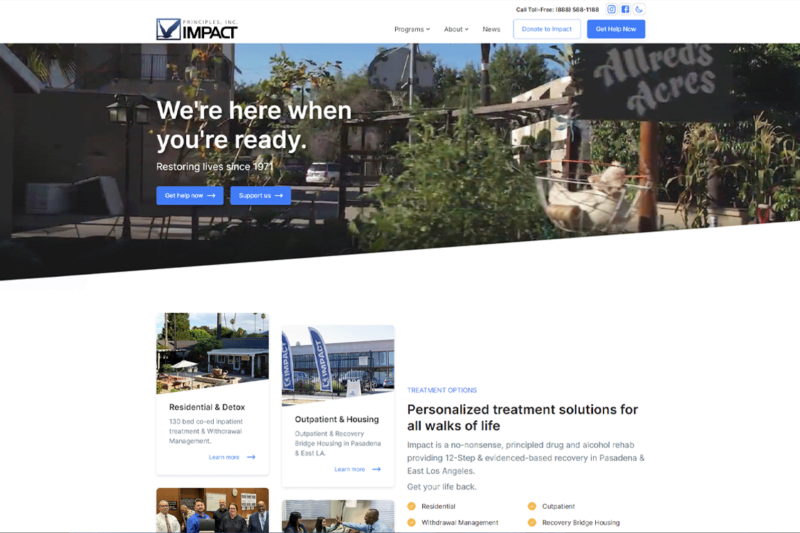

Impact Drug & Alcohol Treatment Center is a Pasadena-based nonprofit treatment provider serving people with substance-use disorders since 1971. Its current continuum includes a 130-bed co-educational residential program with withdrawal management, outpatient and intensive outpatient care, Recovery Bridge Housing in Pasadena and East Los Angeles, court services, family services and long-term aftercare.
The residential campus uses a structured 12-Step and evidence-based model on a 2.5-acre site. The provider describes individual and group sessions, treatment planning, care coordination, relapse prevention, trauma-informed Seeking Safety, daily recovery meetings and support for co-occurring mental-health needs. Program length is individualized; no universal total duration was published on the official pages checked.
Choosing the correct Impact service
Impact’s published service range includes residential treatment, withdrawal management, outpatient care, recovery housing, court assistance, and support for families and graduates. The organization identifies a 130-bed residential program, but that number describes one part of its network. A residential treatment place, an outpatient appointment, and a bed in recovery housing serve different purposes. Ask the admissions team to name the program it recommends and explain where counseling, overnight accommodation, and any withdrawal support would actually take place.
The breadth of this network may matter to someone who expects to need continuing help after an initial treatment episode. It does not mean that every person must pass through every program, or that a housing vacancy establishes clinical eligibility. A useful comparison with another provider should therefore start with the proposed care plan: the initial level, the reasons for that recommendation, and the arrangements for moving to a different level if needs change. The website describes a structured recovery community rather than a package of private resort amenities. Review the official service overview with the admissions recommendation in hand so that the name of the program and the actual service being offered match.
Residential structure and withdrawal limits
The residential page makes an important clinical distinction: Impact provides supervised subacute withdrawal management, but explicitly says it does not provide medical detox. Its admissions staff assesses the required level and can refer someone to another program for medical detox before returning after clearance. Do not use a description of around-the-clock observation as proof that this setting can manage every withdrawal risk.
Residential treatment is organized around individual plans and three phases with personal milestones. The program requires participation in the 12 Steps, including obtaining a sponsor and attending meetings. That expectation is relevant when comparing recovery approaches; it is more than an optional activity on a recreation schedule. The provider reports an average residential period of 90–150 days, with shorter or longer treatment decided individually. That range is not a minimum requirement or a promised discharge date. Impact also describes licensed therapy for co-occurring needs while acknowledging that some people require a higher level of care. Discuss psychiatric symptoms, prescribed medications, recent substance use, and the ability to participate in the program during screening. The residential and withdrawal-management information should guide that conversation.
Outpatient attendance and recovery housing
Impact’s outpatient clinics are in Pasadena and East Los Angeles. The provider describes morning, afternoon, and evening services across six days of the week; an individual’s treatment schedule is generally three to five days weekly. Its published average outpatient duration is four to six months, with adjustment for progress and clinical needs. This is a continuing commitment, even though clients come and go for scheduled services rather than living in the clinic.
Recovery Bridge Housing is a separate accommodation option associated with outpatient participation. It can support people moving from residential treatment as well as some people starting at the outpatient level. Housing should therefore be discussed as a distinct arrangement, including the particular residence, rules, availability, and financial responsibility. Outpatient treatment itself does not provide detox. The page also states that Impact accepts Drug Medi-Cal for residential and outpatient services and describes private insurance and financial-assistance routes. These statements require individual eligibility and benefit checks. Ask for the agreed appointment schedule, housing decision, and payment responsibilities together before planning work or family commitments. The outpatient program description provides the service framework, rather than a guaranteed placement or insurance authorization.
How court-linked treatment is organized
Impact has a distinct court-services function, with clinical documentation and liaison support for people whose treatment intersects with legal proceedings. Its published examples include conditional acceptance letters, confirmation of enrollment, assessments, progress reports, and a representative who may attend court. These are specific services to discuss with the assigned liaison; they should not be treated as a guarantee that any proposed sentence or release arrangement will be accepted.
The provider describes Drug Court participation as lasting approximately nine to fifteen months, usually beginning in residential care and continuing through outpatient treatment. That description concerns the broader court program, not nine to fifteen months of residential accommodation. Initial contact commonly involves an attorney referral and consultation with Impact’s court liaison, followed by screening and the judge’s participation requirements. The judge supervises the legal process while treatment professionals advise on clinical placement. Bring the actual court paperwork and discuss deadlines with your attorney and the treatment team. Clarify who sends reports, what information is reported, and what happens if the clinically recommended level changes. The court-services page explains Impact’s role, but individual legal advice and decisions remain with the appropriate legal professionals and court.
Family involvement and the alumni community
Impact describes family and couples process groups, individual counseling by appointment, and educational opportunities for relatives affected by addiction. Its family-services team includes coordinators and licensed therapists. Participation in counseling is arranged through an invitation from the client’s caseworker or treatment team, reflecting the individual’s plan. Relatives should contact that team before assuming they can join a session, receive clinical updates, or attend a particular event.
The provider states that its family and alumni services and resources are offered without charge. Confirm which activity that statement covers and how to register, especially when organizing travel or time away from work. The alumni network includes gatherings, shared meals, fundraising events, and volunteering. Those activities can provide social connection after treatment, but they are different from an individually scheduled clinical appointment. Families can ask for a clear distinction between education for relatives, joint counseling with the client, and graduate community events. They can also discuss how information-sharing permissions will work and whether separate support is appropriate. The family and alumni information is the starting point for these arrangements; the treatment team determines how family participation fits the client’s care.
Understanding the program’s recovery culture
Impact traces its beginnings to a peer-led initiative in 1969 and the incorporation of Principles, Inc., doing business as Impact Drug & Alcohol Treatment Center, in 1971. The organization describes expansion from that early model into professional treatment, psychological services, family work, court assistance, transitional housing, and aftercare. This history helps explain why community involvement and sustained engagement appear throughout its current service descriptions.
The provider also says many members of its leadership, clinical, and support teams are graduates of Impact. Lived experience can shape the culture a prospective client encounters, but it should be distinguished from the qualifications and responsibilities of the clinician providing a particular service. Ask who will lead individual therapy, oversee the treatment plan, and coordinate other clinical care. The relevant question is how these roles work together for the person seeking help, rather than whether every staff member has the same background. Impact’s organizational history and approach emphasize personal responsibility, structured participation, and recovery relationships. A prospective client can use those priorities to discuss expectations openly and assess whether the program’s daily culture is compatible with their needs.
Planning contact and an assessment
Impact’s contact page distinguishes the residential service’s continuous operation from the published availability of its admissions and treatment team: Monday through Friday, 8:00 a.m. to 4:30 p.m. It also states that a response to an online inquiry may take one or two business days. Someone preparing an admission should therefore clarify when a screening conversation can occur rather than assuming that a submitted form creates an immediate appointment or reserved bed.
The directory separates residential, Pasadena outpatient, and Los Angeles outpatient contacts. Identify the intended service when calling so that the discussion reaches the appropriate team. Have a concise explanation of the help being sought, existing treatment contacts, and any practical barriers ready for that conversation. Ask what documents the team needs and how it wants sensitive clinical information supplied. The contact page directs medical emergencies to 911; an online admission inquiry is not an emergency-response channel. Its current contact information is useful for arranging the next step, confirming the relevant location, and establishing a realistic response time before making travel plans or relying on a particular admission date.
Practical support and financial-assistance limits
Impact’s funding information describes assistance with needs that may remain after initial treatment, including housing, transportation, job-interview clothing, and other practical support. It identifies donations as a way to help with items that other funding may not cover and also acknowledges state, county, and federal financial support. These details show why a discussion of affordability can involve more than the clinical treatment bill alone.
The same page explicitly makes no promise or guarantee of assistance. A prospective client should therefore obtain a specific decision about any requested support instead of including it as an assumed benefit in a personal budget. Distinguish the treatment payment arrangement from help with a particular transport trip, housing need, or employment-related expense. Ask who reviews requests, what information is needed, and when a decision can be expected. A general charitable mission does not establish that a particular expense will be paid for an individual. The provider’s practical-support and funding explanation supports asking about these resources while keeping the limits clear. An agreed plan should identify which assistance is confirmed and which needs still require another arrangement.
Expanded service information reviewed October 19, 2026 using official provider pages. Program placement, current availability, coverage, and personal costs require confirmation with Impact.
Explore the California treatment guide and alcohol treatment information when comparing suitable care.
Impact also lists family and couples services, an alumni network and long-term aftercare. Its public materials indicate that a significant part of its community relies on Medi-Cal, but they do not publish a universal fee, coverage promise or self-pay schedule. Prospective clients should confirm eligibility, availability and individual costs directly. Sources checked October 13, 2026.